Endoscopic Nipple-Sparing Mastectomy

What Is Endoscopic Nipple-Sparing Mastectomy?

Endoscopic nipple-sparing mastectomy (E-NSM) is an advanced minimally invasive approach to mastectomy in which the breast tissue is removed while preserving the breast skin and nipple–areolar complex.

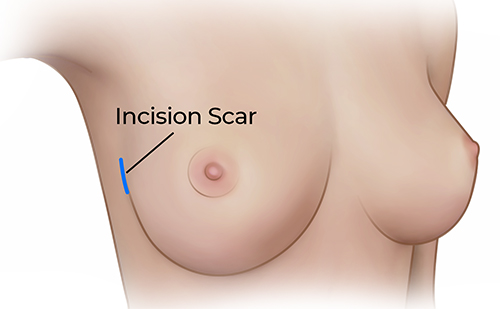
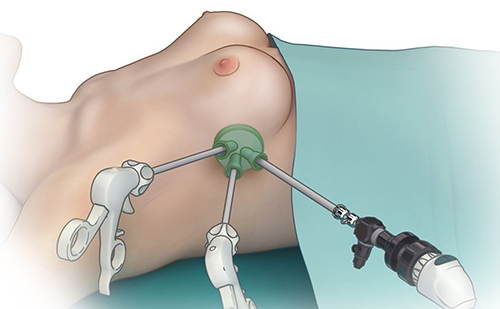
We perform endoscopic nipple-sparing mastectomy through an approximately 4 cm incision hidden within the lateral inframammary fold, where the breast meets the chest wall. A camera and specialised instruments provide a magnified view, allowing the breast tissue to be carefully removed through this relatively small incision.

The aim is to combine the principles of safe mastectomy with preservation of the natural breast envelope and a discreetly positioned scar.

How Is This Technique Different?

In conventional nipple-sparing mastectomy, a longer incision is generally required to provide access to the breast. During open surgery, the skin envelope also needs to be retracted to allow the surgeon to reach different areas of the breast.

With the endoscopic technique, the operation is performed through a smaller lateral inframammary fold incision using a camera and specialised instruments.

Because much of the breast skin remains supported by the surrounding tissues during the operation, there is potentially less disruption to the delicate blood vessels supplying the skin and nipple–areolar complex.

The smaller incision and reduced disruption of surrounding tissues may also help preserve some of the nerve pathways supplying the nipple–areolar complex. Normal nipple sensation cannot be guaranteed, but preservation of sensation is an important consideration in the way the operation is performed.

Why Is the Incision Hidden in the Breast Fold?

Rather than moving the incision completely away from the breast, we places it within the lateral inframammary fold.

This provides direct access to the breast while allowing the scar to sit within a natural crease and remain relatively inconspicuous.

Potential advantages include:

  • An approximately 4-5 cm incision
  • Scar concealed within the lateral breast fold
  • Minimal visible scarring on the front of the breast
  • Preservation of the natural breast skin envelope
  • Less extensive disruption of the skin from surrounding tissues
  • Potential better preservation of blood supply to the nipple and breast skin
  • Potential for better preservation of nipple sensation
  • Immediate reconstruction through the same incision

Who May Be Suitable?

Endoscopic nipple-sparing mastectomy may be considered for selected women undergoing risk-reducing mastectomy, including women with a BRCA1, BRCA2 or other high-risk genetic mutation. It may also be an option for appropriately selected women requiring mastectomy for breast cancer.

Suitability depends on several factors, including:

  • The indication for mastectomy — risk reduction or cancer treatment
  • Breast size and shape
  • Degree of breast ptosis
  • The size and location of the cancer, if present
  • The relationship of the cancer to the nipple and skin
  • Previous breast surgery or radiotherapy
  • Planned reconstruction
  • General health and individual risk factors

Not every patient requiring a mastectomy will be suitable for an endoscopic approach. Cancer safety remains the first priority, and careful review of imaging, pathology and breast anatomy is essential.

The Operation – Step by Step

  • The procedure is performed under general anaesthesia
  • An approximately 4 cm incision is made within the lateral inframammary fold. Through this incision, specialised endoscopic instruments and a camera are introduced.
  • The magnified endoscopic view allows the surgical planes to be identified and the breast tissue to be carefully separated from the overlying skin and underlying chest wall.
  • The breast tissue is then removed through the same incision while preserving the breast skin and, when oncologically safe, the nipple–areolar complex.
  • If lymph node assessment is required, a sentinel lymph node biopsy can also be performed as part of the same operation.
  • Immediate breast reconstruction is then performed where appropriate.
  • Preserving the Nipple:
    • Nipple preservation involves more than simply maintaining its appearance.
    • The blood supply to the nipple–areolar complex is important for healing, while preservation of its nerve supply may influence sensation after surgery.
  • The endoscopic technique is designed to minimise unnecessary disruption of the breast skin and surrounding tissues. The small lateral inframammary incision and limited skin mobilisation may potentially assist in maintaining both vascular and neural continuity to the nipple–areolar complex.
  • However, mastectomy inevitably divides some nerves within the breast. Nipple sensation may therefore be reduced, altered or completely lost, and preservation of normal sensation cannot be guaranteed.
  • Tissue immediately beneath the nipple is also carefully assessed. If cancer involvement of the nipple is identified, removal of the nipple may occasionally be necessary for oncological safety.

Immediate Breast Reconstruction

  • Endoscopic nipple-sparing mastectomy is commonly combined with immediate breast reconstruction.
  • The preserved breast skin and nipple create the natural external envelope for the reconstruction. Depending on the individual patient, reconstruction may involve:
    • Direct-to-implant reconstruction
    • Tissue expander followed by an implant​
  • The reconstructive plan is discussed before surgery and tailored to breast anatomy, cancer treatment and personal preferences.

Recovery After Surgery

Recovery depends partly on the extent of the mastectomy and the type of reconstruction performed.

Most patients can expect:

  • A short hospital stay
  • Temporary surgical drains
  • Swelling, bruising and tightness during the early recovery period
  • A supportive surgical bra during healing
  • Gradual return to normal activities
  • Regular follow-up to assess the incision, breast skin, nipple and reconstruction

The lateral inframammary scar generally becomes less noticeable as it matures and remains hidden within the natural breast fold.

Risks and Possible Complications

Endoscopic nipple-sparing mastectomy remains a major breast operation. Potential risks include, but are not limited to:

  • Bleeding or haematoma
  • Infection
  • Seroma
  • Delayed wound healing
  • Partial or complete nipple–areolar necrosis
  • Breast skin necrosis
  • Reduced, altered or absent nipple sensation
  • Scarring
  • Breast asymmetry
  • Implant-related complications when an implant is used
  • Need for further surgery
  • Anaesthetic complications

Preserving the nipple and breast skin depends on maintaining an adequate blood supply. Despite careful technique, problems with nipple or skin healing can occasionally occur.

Is Endoscopic Mastectomy Less Extensive Than Conventional Mastectomy?

  • The incision is smaller, but the mastectomy itself is not.
  • The same principle of removing the required breast tissue applies whether the operation is performed conventionally or endoscopically.
  • The difference is in how the breast is accessed. Endoscopic magnification and specialised instruments allow the operation to be performed through a small incision while minimising the need for a larger opening in the breast skin.
  • For appropriately selected patients, this can combine oncological surgery with preservation of the breast envelope and a more discreet scar.

Our Approach

At Breast & Wellness, breast cancer surgery is planned around both oncological safety and life after treatment.

A/Prof Meybodi's endoscopic technique uses a small lateral inframammary fold incision rather than placing the scar away from the breast. The aim is to hide the incision naturally while minimising disruption of the breast skin, its blood supply and, where possible, the nerves supplying the nipple–areolar complex.

The decision to use this approach is individualised according to the cancer, imaging, breast anatomy, reconstructive requirements and each patient's priorities.

Key Points

Endoscopic nipple-sparing mastectomy removes the required breast tissue while preserving the skin and nipple–areolar complex when oncologically safe.

  • We perform the procedure through an approximately 4-5 cm incision hidden in the lateral inframammary fold.
  • The breast skin remains largely supported by surrounding tissues during the operation.
  • The technique aims to minimise disruption to the blood supply and nerve pathways of the skin and nipple–areolar complex.
  • Nipple sensation may potentially be better preserved, but normal sensation cannot be guaranteed.
  • Immediate breast reconstruction can usually be performed during the same operation.
  • Cancer safety remains the first priority when deciding whether this approach is suitable.

Why Choose Breast and Wellness Centre?

  • Comprehensive Care: Advanced diagnostic tools for accurate and timely results.
  • Experienced Team: Skilled specialists with extensive experience in breast cancer diagnosis.
  • Personalised Approach: Tailored diagnostic pathways based on your symptoms and risk factors.
  • Compassionate Environment: Supportive care at every step of the diagnostic process.